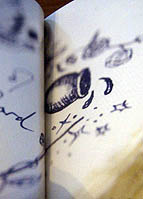
Autora: J. K. Rowling sob o pseudônimo de Beedle, o Bardo.
Capítulo: 1 (primeiro conto).
Ilustradora: J.K. Rowling.

Review
As in her Harry Potter series, garnishing the top of the first page of the first fairy tale, “The Wizard and the Hopping Pot,” is a drawing–in this case, a round pot sitting atop a surprisingly well-drawn foot (with five toes, in case you were wondering, and we know some of you were). This tale begins merrily enough, with a “kindly old wizard” whom we meet only briefly, but who reminds us so much of our dear Dumbledore that we must pause and take a breath.
This “well-beloved man” uses his magic primarily for the benefit of his neighbors, creating potions and antidotes for them in what he calls his “lucky cooking pot.” Much too soon after we meet this kind and generous man, he dies (after living to a “goodly age”) and leaves everything to his only son. Unfortunately, the son is nothing like his father (and entirely too much like a Malfoy). Upon his father’s death, he discovers the pot, and in it (quite mysteriously) a single slipper and a note from his father that reads, “In the fond hope, my son, that you will never need this.” As in most fairy tales, this is the moment when things start to go wrong….
Bitter about not having anything but a pot to his name and completely uninterested in anyone who cannot do magic, the son turns his back on the town, closing his door to his neighbors. First comes the old woman whose granddaughter is plagued with warts. When the son slams the door in her face, he immediately hears a loud clanging in the kitchen.
His father’s old cooking pot has sprouted a foot as well as a serious case of warts. Funny, and yet gross. Vintage Rowling. None of his spells work, and he cannot escape the hopping, warty pot that follows him–even to his bedside. The next day, the son opens the door to an old man who is missing his donkey. Without its help to carry wares to town, his family will go hungry. The son (who clearly has never read a fairy tale) slams the door on the old man. Sure enough, here comes the warty, befooted clanging pot, now having captured both the sounds of a braying donkey as well as groans of hunger. [Spoiler alert!] In true fairy tale fashion, the son is besieged with more visitors, and it takes a few tears, some vomit, and a whining dog before the wizard at last succumbs to his responsibility, and the true legacy of his father.
Renouncing his selfish ways, he calls for all townspeople far and wide to come to him for help. One by one, he cures their ills and in doing so, empties the pot. At the very last, out pops the mysterious slipper–the one that perfectly fits the foot of the now-quiet pot–and together the two walk (and hop) off into the sunset.
Rowling has always made her stories as funny as they are clever, and “The Wizard and the Hopping Pot” is no exception; the image of a one-footed cooking pot plagued with all the “warty” ills of the village, hopping after a selfish young wizard, is a good example. But the real magic of this book and this particular tale lies not just in her turns of phrase but in the way she underlines the “clang, clang, clang” of the pot for emphasis, and how her handwriting gets messier when the story picks up speed, like she’s hurrying along with the reader. These touches make the story uniquely her own and this volume of stories particularly special.